


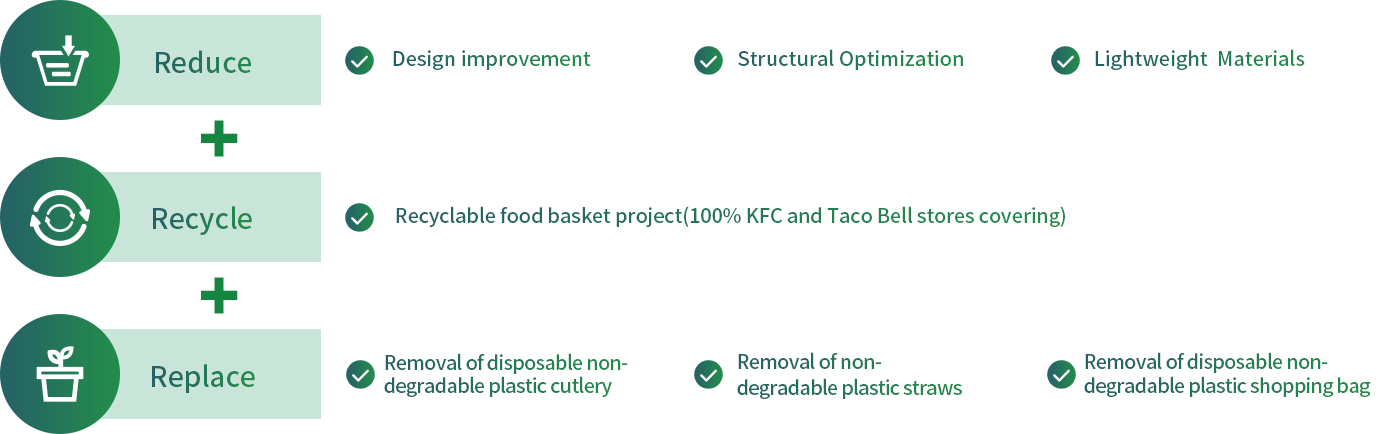
We strictly comply with the national laws and regulations on the use of packaging and set a series of commitments and goals. Guided by our 4R Principles, we have released the Yum China Packaging Strategy to accomplish the commitments and goals by developing sustainable packaging solutions, such as packaging reduction, innovative approaches for reusable packaging, and material replacement.


From the enforcement of China's Anti-Food Waste Law to the widespread promotion of the "Clean Plate Campaign", reducing food waste has become a broad societal consensus. Yum China actively supports the national Action Plan for Grain Conservation and Anti-Food Waste, embedding the principle of minimizing food loss and waste throughout our operations. We adopted innovative technologies and scientific management methods to reduce food loss and waste across our entire value chain, from purchasing, transportation, and processing, to dispose. We are working towards our 2030 goal of 10% reduction of food waste per restaurant by 2030 as compared to the 2020 baseline.
In 2025, we further integrate food waste reduction practices into daily restaurant operations, while steadily improving overall efficiency. By monitoring real-time product sales data, we promptly fine-tune system settings and flexibly adjust selling windows, ensuring that more items are served at their optimal time. For seasonal or limited-time offerings, we use advanced algorithms to help accurately forecast ingredient needs and track remaining inventory, pairing these insights with targeted promotions to accelerate sell-through and achieve highly efficient inventory management.
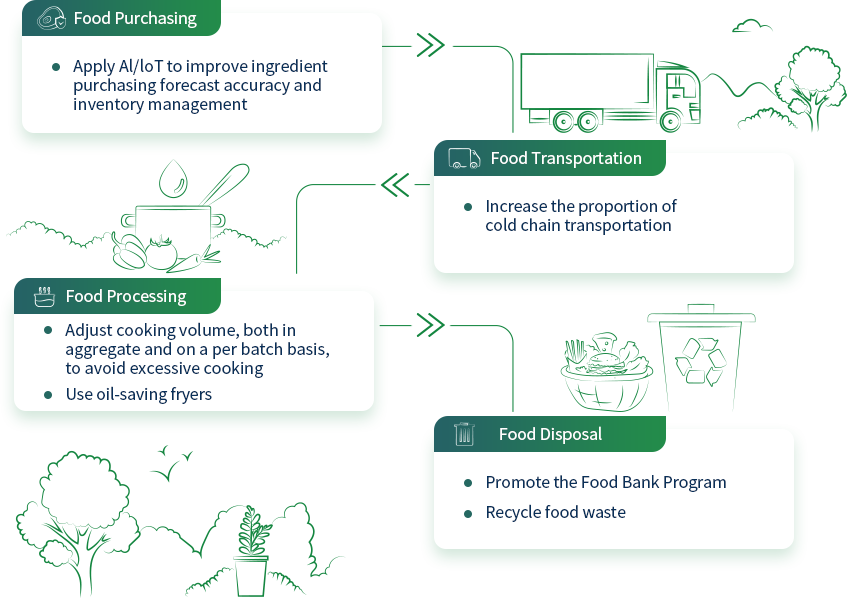
In 2020, KFC launched the Food Bank program in line with our commitment to minimizing food waste. Leveraging its restaurant operations, KFC pioneered this model in the restaurant industry that distributes unsold food, still within the shelf life, free of charge to community residents in need. This initiative not only brings warmth from Yum China to local communities but also fosters a deeper public awareness that surplus food is still good and should not be wasted.
With over five years of development, KFC has continuously refined the operational model of the Food Bank. We created standardized operating manuals, delivered systematic employee training, and established clear protocols for every step, from food collection and secure packaging to quick-freezing, storage, and community pickup, ensuring safety, hygiene, and consistency at every stage. On Earth Day 2025, KFC rolled out the themed campaign celebrating the ambitious milestone of 1,000 stations in five years to raise community awareness of food conservation through online and offline engagement. As of the end of 2025, KFC Food Bank has expanded to cover 190+ cities nationwide and ~1,300 stores, achieving the ambitious milestone of "1,000 stations in five years".